

What are WHMIS symbols?
The Workplace Hazardous Materials Information System (WHMIS) updated the term symbols to pictograms in 2015 to align with the Globally Harmonized System of Classification and Labelling of Chemicals (GHS). They’re visual tools used to quickly convey the hazards associated with hazardous products. WHMIS pictograms use symbols to show health risks associated with a hazardous product: for example, if it’s toxic or corrosive.
What are WHMIS pictograms?
Most WHMIS pictograms feature a distinctive red, diamond-shaped border around a symbol. The symbol inside the red border represents the potential hazard. It’s important to understand that the entire pictogram, including the red border and the symbol, signifies the hazard. Each pictogram corresponds to specific hazard classes and categories, ensuring consistent communication of risk.
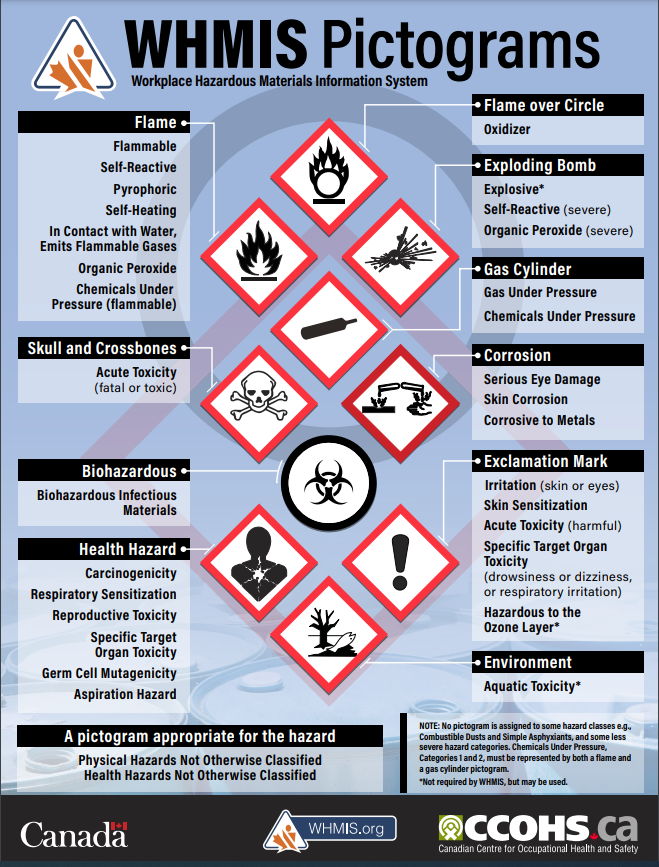
To help you identify the different types of WHMIS symbols and pictograms, refer to the graphic below, which displays the different hazard pictograms.
- The bold text indicates the name of the pictogram.
- The words in brackets describe the hazard it represents.
How many WHMIS symbols and pictograms are there?
While the exact number of WHMIS symbols and pictograms can sometimes vary slightly based on specific subcategories or updates to the GHS system, which WHMIS aligns with, there are ten core WHMIS pictograms to know.
These ten pictograms cover the most common and significant hazard classes. It’s crucial to understand each of these symbols as they provide a quick visual cue to the type of hazard a product presents.
Important: The environmental hazard pictogram is a GHS environmental category and not mandatory under WHMIS labelling in Canada; employers may still include it for awareness/training.
These ten core pictograms are:
- Exploding Bomb (explosive/self‑reactive/organic peroxide hazards): A bomb-like symbol indicating a risk of explosion.
- Flame (flammables, self‑reactives, pyrophorics, self‑heating, emits flammable gas, organic peroxides): A flame symbol representing flammability hazards.
- Flame Over Circle (oxidizers): A flame over a circle, indicating that the chemical can cause or intensify a fire.
- Gas Cylinder (gases under pressure): A gas cylinder symbol for compressed gases.
- Corrosion (corrosive to metals; skin/eye corrosion): A symbol showing a chemical corroding metal and a hand, representing corrosive damage.
- Skull and Crossbones (acute toxicity – severe): A skull and crossbones symbol for highly toxic substances.
- Exclamation Mark (acute toxicity – harmful, skin/eye irritation, specific target organ toxicity – single exposure [drowsiness/dizziness], respiratory irritation): Indicates various immediate health effects.
- Health Hazard (Silhouette with starburst in chest) (carcinogenicity, respiratory sensitization, germ cell mutagenicity, reproductive toxicity, specific target organ toxicity – repeated exposure, aspiration hazard): Represents serious long-term health hazards.
- Biohazardous Infectious Material: A symbol with three interlocking circles, indicating biological hazards.
- Environmental Hazard (Non‑mandatory under WHMIS): A dead tree and a dead fish represent hazards to the aquatic environment.
It’s important to remember that these pictograms are standardized and easily recognizable. Their consistent design helps ensure that hazard information is communicated clearly and effectively across different workplaces and even internationally.
What are the WHMIS hazard groups?
WHMIS deals with two main groups of hazards: physical hazards and health hazards. Understanding these categories is crucial for safe handling and storage of chemicals in the workplace. Each group includes various hazard classes that have specific hazardous properties. Let’s explore them in more detail.
Physical hazards
Physical hazards relate to the physical or chemical properties of a product that can pose a danger. These hazards can cause immediate harm, such as fires, explosions, or damage to property. These hazards are about what the product does when it’s mishandled or comes into contact with certain conditions.
Health hazards
Health hazards, on the other hand, are concerned with the potential of a product to cause health effects. These effects can be immediate or long-term. It’s about what the product does to your body if you are exposed.
Understanding the difference between physical and health hazards, and the specific classes within each group, is fundamental to interpreting WHMIS pictograms and ensuring workplace safety.
Tip for supervisors: During toolbox talks, ask workers to point to the pictograms on actual product labels in use that day and explain the control measures (ventilation, PPE, segregation).
What are the WHMIS hazard classes?
WHMIS hazard classes group together hazardous products that share similar properties. These classes are widely used internationally by countries that have adopted the Globally Harmonized System of Classification and Labelling of Chemicals (GHS). However, some hazard classes are unique to WHMIS.
Think of hazard classes as a way to organize hazardous materials into groups with similar dangers. This makes it easier to understand the risks associated with a product and implement appropriate safety measures. For example, all flammable liquids, regardless of their specific chemical composition, would fall under the « Flammable Liquids » hazard class.
Why are WHMIS symbols and hazard classes important?
- Quick Identification of Hazards: Knowing the hazard class of a product allows workers to quickly understand the potential dangers involved.
- Appropriate Handling and Storage: Different hazard classes require different handling and storage procedures. Understanding these classifications ensures the safe handling of hazardous materials.
- Consistent Communication: The use of standardized hazard classes ensures consistent communication of hazard information across different workplaces and even internationally.
- Regulatory Compliance: Adhering to WHMIS hazard class regulations is essential for workplace safety and legal compliance.
In the following sections, we’ll delve into the specific physical and health hazard classes defined by WHMIS symbols, providing detailed explanations and examples of each. This will give you a comprehensive understanding of how hazardous materials are classified and how to interpret WHMIS pictograms and labels effectively.
Physical hazard classes
Common examples of physical hazard classes include:
| Physical Hazard Class | Class Description |
| Flammable gases, Aerosols, Flammable liquids, and Flammable solids | Products that ignite or explode easily. The main hazards are fire or explosion. The aerosols class also includes a category for non-flammable aerosols that may be a hazard if exposed to heat or flame. |
| Oxidizing liquids, solids, and gases | Products that are classified as oxidizers can cause or intensify a fire or explosion. |
| Gases under pressure | Products in this class include compressed, liquefied, dissolved, and refrigerated gases. The main hazard are the high pressures contained in the cylinder or container. Refrigerated liquefied gases can be cold enough to cause severe cryogenic burns. The product container may also explode if exposed to heat. |
| Self-reactive mixtures and substances | These products can cause a fire and react on their own. They can also cause an explosion if exposed to heat or flames. |
| Pyrophoric liquids and solids | These products catch fire spontaneously if exposed to air. |
| Self-heating substances and mixtures | These are products that may catch fire if exposed to air. They differ from pyrophoric liquids and solids in that they ignite after a longer exposure period or when found in large quantities. |
| Substances and mixtures that emit flammable gases when in contact with water | These products react with water and release flammable gases that may ignite quickly or spontaneously. |
| Organic peroxides | Products that, if exposed to heat, may cause a fire or explosion. |
| Corrosive to metals | These products can chemically damage, corrode, or destroy metals. |
| Combustible dust | These are products that are finely ground or divided into solid particles. These particles may catch fire or explode if dispersed into the air. |
| Simple asphyxiants | These products are gases that can displace oxygen in the air and can cause rapid suffocation. |
| Physical hazards not otherwise classified | This class covers physical hazards not classified under other physical hazard classes. The hazard must result from a chemical reaction that can cause severe injury or death at the time of the reaction to be included here. If a product is classified under this class, the hazard statement on the label and SDS provides a detailed description of the hazard. |
| Chemicals under pressure | This class includes liquids or solids packaged in a container other than an aerosol dispenser, which are pressurized with a gas at a pressure of 200 kPa or more at 20 °C and excludes any gas under pressure |
Verification note: “Chemicals under pressure” appears in newer GHS revisions. Confirm current Canadian adoption status before including in regulated training materials; if included here, label as informational.
Health hazard classes
Examples of health hazard classes include:
| Health Hazard Class | Hazardous Product Description |
| Acute toxicity | Products that can be fatal, toxic, or harmful if in contact with skin, inhaled, or swallowed. Refers to effects after a single/short exposure. |
| Skin corrosion/irritation | Cause severe skin burns (corrosion, ulcers, bleeding, scabbing) or skin irritation. |
| Serious eye damage/eye irritation | Cause serious eye damage (including tissue damage or vision loss) or irritation. |
| Respiratory or skin sensitization | Respiratory sensitizers can induce asthma/allergy symptoms if inhaled; skin sensitizers can trigger allergic responses on contact. |
| Germ cell mutagenicity | May cause or are suspected of causing heritable gene mutations. |
| Carcinogenicity | May cause cancer or increase its likelihood. |
| Reproductive toxicity | Can damage fertility, harm the unborn child, or cause effects via lactation. |
| Specific target organ toxicity – single exposure | Harms organs (e.g., liver, kidneys, blood) after one exposure; includes respiratory irritation and drowsiness/dizziness. |
| Specific target organ toxicity – repeated exposure | Causes or may cause organ damage after prolonged/repeated exposure. |
| Aspiration hazard | Liquids/solids that, if aspirated into the lungs, can cause chemical pneumonia, lung damage, or death. |
| Biohazardous infectious materials | Microorganisms, nucleic acids, or proteins that cause/suspected to cause infections. |
| Health hazards not otherwise classified | Hazards not included in other classes; adverse effects may be fatal after acute or repeated exposure. |
What are the WHMIS symbols and hazard categories?
Every WHMIS hazard class has at least one hazard category assigned to it. Each hazard category is identified by an alphabetical letter: A, B, and so on. Some hazard classes have subcategories identified by a combination of a number and a letter, for example, 1A, 1B, and so on.
Generally, a lower number or earlier letter in the alphabet indicates a higher degree of hazard. So category 1A is more hazardous than 1B, while 1B is more hazardous than 2A, and so on. While some hazard classes have only one category, others can have five categories or more. Understanding the hazard categories helps users to identify hazardous materials at a glance.
Exceptions and special cases for some WHMIS symbols
While the letter/number system is common, there are some exceptions:
- Gases Under Pressure: Instead of the typical A, B, C system, gases under pressure are categorized based on their physical state when packaged: For example, compressed gas or liquefied gas. These categories describe the packaging method, not the specific level of danger the gas poses. You’ll need additional information (like the gas’s flammability or toxicity) to understand the full hazard.
- Reproductive Toxicity: This class has a subcategory called “Effects on or via Lactation,” This subcategory doesn’t have any specific numbered category assigned to it. Additionally, reproductive toxicity comprises categories 1 and 2, which are related to the effects on fertility or the unborn child. Although considered a different hazard, the effects on or via lactation are related to the reproductive toxicity class.
Scope reminder: Some substances (e.g., consumer products, explosives, radioactive materials, wood/wood products) are regulated under other Canadian legislation and may be excluded from WHMIS labelling—verify coverage via SDS/Canadian regulations.
Suppliers must assess products covered by the Hazardous Products Act against specific criteria as mandated by the Hazardous Products Regulations. A product is considered hazardous if it meets any of the criteria for a hazard class. All hazardous products should be labelled according to the regulations and accompanied by a corresponding safety data sheet (SDS).
The SDS provides the hazard class and category in Section 2 (Hazard Identification). Each hazard class or category must use specific pictograms and label elements to indicate the hazard present and appropriate precautions to take. Use the information provided by the label and SDS to be informed and know how to safely use, handle, store, and dispose of the hazardous product.
Employers have a responsibility to ensure that the most up-to-date version of the SDS is readily available for all hazardous products found in the workplace.
Audit tip—Set a quarterly reminder to check supplier portals for SDS updates; keep latest versions on file and accessible to workers.
Is WHMIS training required?
All Canadian jurisdictions require that employers develop, implement, and maintain a worker WHMIS education and training program. WHMIS training requirements are designed to ensure workers easily recognize hazardous products and identify what makes them a hazard.
This helps users better protect themselves and others from potential hazards associated with hazardous products. WHMIS and its symbols aim to help employees work safely with hazardous products and know where to find information about them quickly. The ultimate goal of any WHMIS training activity should be safety. To ensure that, it is essential to receive the appropriate WHMIS training.
Do you need help with your WHMIS training identification?
The understanding and implementation of WHMIS is vitally important for maintaining a safe and healthy work environment in Canada. From being able to identify and recognize hazard classifications, to accessing critical information through the use of safety data sheets, WHMIS allows workers to protect themselves and their colleagues from potential dangers of hazardous products.
Enhance your organization’s WHMIS training with our health and safety experts by your side!
While WHMIS is a legal requirement, it is not only about compliance. It is also there to help build an understanding of potential risks and how to mitigate them daily. Making sure that your team has appropriate WHMIS training helps demonstrate an employer’s commitment to safety in the workplace. If you’re looking for resources to enhance your WHMIS program or ensure your team receives top-tier online WHMIS training. Citation Canada offers a range of health and safety and training solutions to meet your specific needs. Visit our website to learn more about our training courses and safety resources.
Need help understanding the changes coming to WHMIS for 2025?
With the transition period to comply with the amended WHMIS requirements ending this December 14, it’s time to ensure your organization maintains compliance. To help, our experts have created a WHMIS Bulletin for 2025, offering practical guidance on the latest updates and changes to hazard classes, categories, classifications, safety data sheets, product labels, training records, and more.