Creating policies that keep pace with developing legislation
A well-crafted policy manual and its policies help clarify employee rights and responsibilities, streamline operations, and create a positive workplace culture. Clear, established policies showcase an organization’s commitment to legal compliance and equitable treatment of workers. Without clear policies, businesses risk costly penalties for noncompliance, workplace disputes, and operational inefficiencies.
Compliance with legislation
The Ontario government requires provincially regulated employers to have certain policies in place. Last year, we supported over 6,000 clients across Canada with the policy templates, supporting content, training, and trusted advice they needed. This collaboration allows HR professionals and business leaders to concentrate on what matters most—driving growth and reaching strategic goals.
Plan for developing legislation
HR and health and safety legislation are continually evolving, requiring businesses to stay informed and adaptable. Additional policies may be legislatively required depending on factors like the organization’s size, the nature of its work, and the industry it operates within. Policies that weren’t needed in the workplace previously may be required later as an organization evolves. For example, in Ontario, if you employ 25 or more employees, you must have written policies on disconnecting from work and electronic monitoring
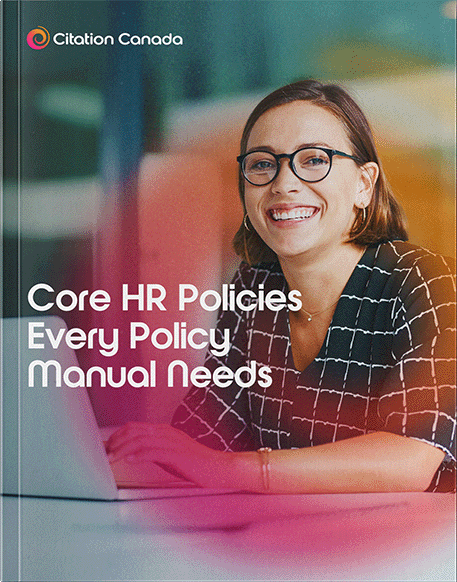
In this guide, we’ll outline the core HR policies every policy manual should include for businesses operating in Ontario. We briefly explain the purpose of each policy and provide tips on how to effectively implement and communicate these policies in your organization.
In 2025, 95% of HR managers reported having challenges finding skilled professionals.
Robert Half, 2025 Job Market Overview
WHMIS 2025 amendments
The 2025 WHMIS amendments aim to enhance worker safety by requiring more detailed health and safety
information on labels and safety data sheets. These updates help workers better understand and protect
themselves from workplace hazards.
Coming into force in 2025
Amendments to the Hazardous Products Regulations (HPR) came into force on December 15, 2022, to
better align Canadian legislation with the Globally Harmonized System of Classification and Labelling of
Chemicals (GHS). A three-year transition period, ending December 14, 2025, allows suppliers, employers, and workers, to adapt to the changes. This ensures nationwide consistency through coordination across federal, provincial, and territorial jurisdictions.
Compliance during the transition period
During the three-year transition, regulated parties may comply with either the former or amended HPR, but not both. Hazard classifications, safety data sheets (SDSs), and labels (if applicable) must fully follow the chosen version of the regulation. Employers should work with their suppliers to understand what version of HPR their SDSs and labels comply with, make any changes to ensure consistency, and plan for the transition by the compliance date as necessary. Be ready to demonstrate which version your product
complies with if requested.
Key updates
The recent amendments bring several key updates: clearer and more precise provisions, new required
elements for safety data sheets, and the introduction of a new physical hazard class: chemicals under
pressure. Additionally, there’s now a hazard category for non-flammable aerosols and subcategories for
flammable gases. Check out the points below for a detailed breakdown of these changes.
WHMIS changes for 2025
Here’s a quick overview of the major updates and amendments to the HPR that are coming into effect.
Administrative updates to WHMIS for 2025
- Transition period: A new, unified three-year transition is in force for all stakeholders.
New WHMIS safety data sheet and product label requirements
- Combustible dust: New hazard statement option added: “May form explosible dust–air mixture.”
Changes to WHMIS exemptions for confidential business information
- Rules for situations where hazardous products are sold to employers who file confidential business information claims have been updated to require the inclusion of information beyond product identifier and initial supplier identifier on SDSs and labels.
WHMIS updates for significant new data
- When a supplier must provide, obtain, or prepare a written document to reflect significant new data, it must include changes to the SDS or label that are required resulting from the new data and the date the data becomes available.
New WHMIS hazard classes and categories
- Chemicals under pressure: Introduced as a new physical hazard class.
- Aerosols: A new Category 3 class has been added for non-flammable aerosol products.
Changes to WHMIS safety data sheets
- Concentration ranges: Narrower concentration ranges that fall within one of the prescribed ranges are permitted for inclusion on SDSs.
- Disclosure of hazardous ingredients: All hazardous ingredients in a mixture at concentration levels above relevant cutoff levels must be disclosed, even if the ingredients don’t affect the mixture’s classification.
New WHMIS classification criteria
- Flammable gases: Includes new flammable gases subcategories under Category 1.
- Pyrophoric gases: The pyrophoric gases hazard class is repealed, and any products classified in the repealed class are now under new subcategories within flammable gases – category 1A.
- Water-activated toxicants: When substances and mixtures meet criteria to be classified as “acute toxicity (inhalation),” and the substances or mixtures are also water-activated toxicants, their classification is now based on the acute inhalation toxicity.
- Health hazard classes that have categories and subcategories: Mixtures may now be classified into subcategories when sufficient data is available. In the previous version, only classification criteria for categories, not subcategories, was provided.
- Reproductive toxicity – category 2: Clarification added to ensure adverse effects observed in humans and animals must not be considered as secondary non-specific consequences of other toxic effects.
These updates aim to improve clarity, safety, and compliance for workers. Be sure to review the Hazardous Products Act and the Hazardous Products Regulations in detail, and consult a trusted HR professional or legal counsel before making any changes to workplace policies.
Here are some of last year’s top downloads by Ontario employers
- Health and Safety Policy: This written policy outlines an organization’s approach to managing workplace health and safety. It defines roles and responsibilities and sets out the expectation to maintain a safe and healthy environment for employees and others in the workplace.
- Workplace Violence and Harassment Policy: Workplace violence, harassment, and sexual harassment are recognized hazards under the Occupational Health and Safety Act (OHSA), which defines clear responsibilities for employers, supervisors, and workers in preventing and responding to these risks. Employers are required to develop and maintain written policies and programs, review them at least annually, provide appropriate training, ensure incidents are reported and investigated, and take steps to support and protect affected workers.
- Accessible Employment Policy (AODA): A workplace accessibility policy is required by the Accessibility for Ontarians with Disabilities Act, 2005 (AODA) and reflects an organization’s commitment to removing barriers and fostering equal opportunities for individuals with disabilities. This policy specifically addresses accessibility in employment practices, including recruitment, accommodation, and workplace support.
What’s trending?
More recent HR policies have trended towards topics surrounding the widespread adoption of AI and the digital transformation of the workplace. Examples include the following:
- Artificial Intelligence (AI) Usage Policy: This policy outlines guidelines for employees using AI tools for work-related tasks. The policy prohibits using AI for unauthorized purposes and requires compliance with human rights, accessibility, privacy, and copyright laws.
- Disconnecting from Work Policy: If you employ 25 or more employees on January 1 of a given year, you must have this policy in place before March 1 of that same year. Along with being a legal requirement for many employers, this policy also demonstrates a commitment to employees’ work–life balance and wellbeing.
- Electronic Monitoring Policy: As above, if you employ 25 or more employees as of January 1 of a given year, you must have a written policy in place before March 1 of that same year that outlines what, if any, electronic monitoring occurs in the workplace. This policy can be further supported by a Technology, E-mail, and Internet Use Policy. With these policies in place, you can show employees that you are upfront about the expectations around acceptable use of technology, the monitoring of that technology, and what you will do with that information.
Other key policies commonly recommended to help address compliance obligations
Employers have a range of legislative obligations to meet under various statutes, including the Ontario Human Rights Code, the Occupational Health and Safety Act, the Employment Standards Act, 2000, and applicable privacy laws. While not all of these obligations need a specific policy, we recommend that employers in Ontario implement these commonly used policies to support compliance and align with best practices. Additional measures may be needed depending on the specific legal requirements applicable to the workplace.
- Reporting Workplace Accidents and Injuries Policy: This workplace incident reporting policy outlines the responsibilities of employees and the company in managing workplace injuries and serious incidents. The policy ensures compliance with applicable legislation, supports injured employees, and prohibits any actions discouraging injury reporting.
- Hazard Identification and Control Policy: This policy outlines how to identify, assess, and manage workplace hazards to ensure a safe environment for employees. It focusses on preventing risks through proactive measures and controls.
- Health and Safety Committee/Representative Policy: This policy outlines the roles and responsibilities of designated representatives or committees responsible for promoting workplace health and safety. It ensures that employees and management have a voice in health and safety matters.
- Workplace Hazardous Materials Information System (WHMIS) 2015 Compliance Policy: This policy ensures that hazardous materials are properly labelled, stored, and handled following the Globally Harmonized System (GHS) standards.
- Human Rights Policy (Accommodation): This policy prohibits discrimination and harassment in the workplace based on race, gender, sexual orientation, age, religion, and other prohibited grounds. It also outlines the employer’s duty to accommodate individuals based on a protected characteristic.
- Hours of Work Policy: This policy sets out the standard work hours and other regulations related to employee working hours. It also covers flexible work arrangements and time-off requirements.
- Attendance Management and Absenteeism Policy: This policy outlines expectations for employee attendance, reporting absences, and consequences for unapproved absenteeism.
- Progressive Discipline Policy: This policy provides a framework for managing employee misconduct through a series of progressive steps. While it promotes consistency, it also allows for flexibility based on the severity of the situation.
- Confidentiality Policy: This policy ensures that all employees understand the importance of maintaining confidentiality in the workplace and outlines consequences for breaches of confidentiality.
- Pay Equity Policy: This policy supports compliance by ensuring that jobs commonly held by women are compensated fairly in comparison to jobs of comparable value commonly held by men. It aims to identify and eliminate gender-based wage discrimination in compensation practices.
Employers with 10 or more employees should be aware that although a pay equity policy is not mandatory, a pay equity plan is required. We recommend implementing a pay equity policy to support the creation and maintenance of a pay equity plan.
These policies can help protect your organization against discrimination claims and workplace accidents. They are also essential for setting expectations on acceptable employee conduct and holding all workers to the same standard.
This isn’t an exhaustive list, but rather a selection of core policies we frequently recommend based on their impact and relevance in most workplaces. If you have questions about legislative obligations or about which policies are required in the jurisdictions your organization operates within, speak with a trusted HR professional or contact our Live HR Advice team.
How Citation Canada helps:
Policies built to meet your vision and the needs of the organization
Create and action policies your way with our HR content and HRIS:
- Using our intelligent software, we’ll guide you through the process, asking targeted questions designed to create a policy manual that will help you accomplish your goals while ensuring your company’s protection.
- Have a pre-written document you need to include in your policy manual? Upload it to the platform and seamlessly integrate it with your manual.
- Choose from over 300 up-to-date templates backed by our experts that you can update and assign with just a few clicks.
Important takeaways
Planning a thorough policy audit is an excellent way to ensure your organization is prepared to navigate potential HR challenges and maintain compliance with developing legislation. Although it may seem time-consuming and labour-intensive, remember that these policies are there to protect workers and the organization. Spending time on this process is a wise and strategic choice, and using reliable HR software can help enhance efficiency and streamline workflows.
Our intelligent software guides you through a simple question and answer process to generate a tailored policy manual. Using expertly crafted templates, it builds a polished, organized guide you can easily review and customize. It’s fast, flexible, and built to protect your business.
Here’s how we support the Canadian businesses driving our economy
Stay ahead of compliance requirements: Our HR software keep a close watch on evolving legislation. When changes occur, you will receive recommendations to update your policies automatically, ensuring that compliance requirements are met with ease.
Centralized policy management: Easily manage all your policies in one centralized platform, and assign them to employees to help them stay informed, engaged, and accountable.
Interactive online training: Our online library offers a diverse collection of training courses designed to accommodate a variety of learning styles, ensuring the information is accessible to all workers. Give your employees the knowledge they need through our extensive course catalogue. Our offerings include WHMIS, Workplace Violence and Harassment, Occupational Health and Safety Awareness, AODA Customer Services Standards, and Understanding Human Rights training courses.
Strengthen workplace policies with advice from our HR and health and safety experts
Assigning policies like these is easy with a user-friendly human resources information system like Atlas, our intelligent HRIS. To determine applicable policies for your organization and jurisdiction, book a demo and see our software and support services in person.
Discover our conveniently priced plans for trusted HR and health and safety advice, which include our award-winning HR software and on-site support.
If you’d like to see one of our policy templates or get a firsthand look at our platform, book a with one of our experts today.