
Reduce Fatigue and Injuries with Safe Lifting Techniques
Safe lifting techniques are crucial for protecting employees in the workplace. They help prevent permanent or long-term health issues that can affect your ability to perform your job and can have devastating effects on your personal life. Safe operating procedures and safety software can help streamline and simplify some of these tasks, putting steps in place to help reduce lifting injuries among your workers.
Most workplace injuries from improper lifting occur when trying to move large, heavy objects. This fact creates a false sense of security for some employers whose employees primarily work in an office setting, but as we explain in this blogpost, lifting injuries can occur anywhere, with any weight.
Proper techniques and lifting equipment help prevent injuries
It’s not just what you carry but how you carry it that makes the difference. While jobs involving consistent manual labour (such as construction, warehouse, or factory roles) carry a higher risk, workplace injuries can occur in any industry and in any situation. According to the WSIB, there were over 235,000 registered claims in 2025, and more than 75,000 of those resulted in lost time.
Employers are responsible for taking steps to reduce lifting injuries in their workplaces. Effective employee training, proper lifting techniques, and assistive equipment can greatly reduce the risk of employees injuring themselves from using improper lifting techniques.
Be mindful of the risks when setting a pace of work
Pressure to maintain a specific pace of work can create the belief that tasks must be completed immediately, leaving little opportunity for rest. This mindset leads to both mental and physical strain, causing muscle tension and fatigue and making workers more vulnerable to injury when additional lifting is required. For example, the pace of work often affects how frequently workers must lift, so as the pace increases, the likelihood of injury also rises.
Lifting injuries often occur in jobs where piecework or a set work pace ties into productivity targets. When leadership strictly enforces this pace, it can increase worker discomfort and, in turn, contribute to musculoskeletal injuries. This can also place pressure on workers to find shortcuts or workarounds that may lead to more serious injuries or workplace accidents.
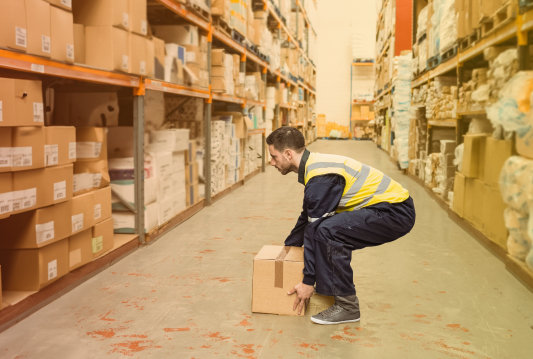
This repeated heavy lifting or sudden awkward movement can cause strain to back muscles and spinal ligaments. As a result, workers need to focus on the basics, such as bent legs, having the load close to the body, and always keeping a straight back, and understand what they’re carrying and where they’re carrying it to.
Some easy-to-follow, proper lifting techniques
- Keep a wide base of support. Your feet should be shoulder-width apart, with one foot slightly ahead of the other.
- If you need to squat, bend at the hips and knees only. If needed, place one knee on the floor and your other knee in front of you, like a half-kneel.
- Make sure you have good posture by looking straight ahead, keeping your back straight, chest out, and shoulders back. This helps keep your upper back straight while having a slight arch in your lower back.
- Lift slowly by straightening your hips and knees (not your back). Remember not to twist as you lift.
- Keep the load as close to your body as possible, around your navel.
- Remember to use your feet to change direction by taking small steps. Don’t twist!
- Keep your shoulders in line with your hips as you move.
- When putting the item down, reverse the process and squat with the knees and hips only.
A single workplace injury caused by improper lifting techniques can significantly affect a business, from workers’ compensation issues and reduced productivity to low morale regarding safety concerns and higher staffing expenses.
Lifting injuries are preventable
Discover how Citation Canada’s health and safety solutions give your employees the knowledge they need to lift and work safely at your organization.
Our safety software and live advice solutions have helped over 6500 Canadian businesses with:
- Implementing compliant OHS documentation: Access a health and safety content library containing hundreds of templates, checklists, and documents covering everything from workplace investigations to risk assessments and more.
- Managing and assigning online employee training courses, tailored to your business’s needs: Our online training platform offers hundreds of courses that ensure your people have the knowledge they need to work safely in any workplace environment.
- Accessing live health and safety advice when you need it: When you need answers about the specifics of workplace investigations, or anything else, our team of OHS consultants is there to provide trusted guidance online, over the phone, or during a site visit.
While Citation Canada uses reasonable efforts to maintain this blog and its services in an up-to-date fashion, it does not warrant the completeness, timeliness, or accuracy of any information contained on this blog or any of its services, whether in English or French, and may change them at any time at its sole discretion without notice. All information and services provided by Citation Canada are provided to members and users “as is,” “with all faults,” “as available,” and at the sole risk of members and users. Our human resources information and recommendations are based on seasoned, best practice field experience and should not be construed as legal advice.